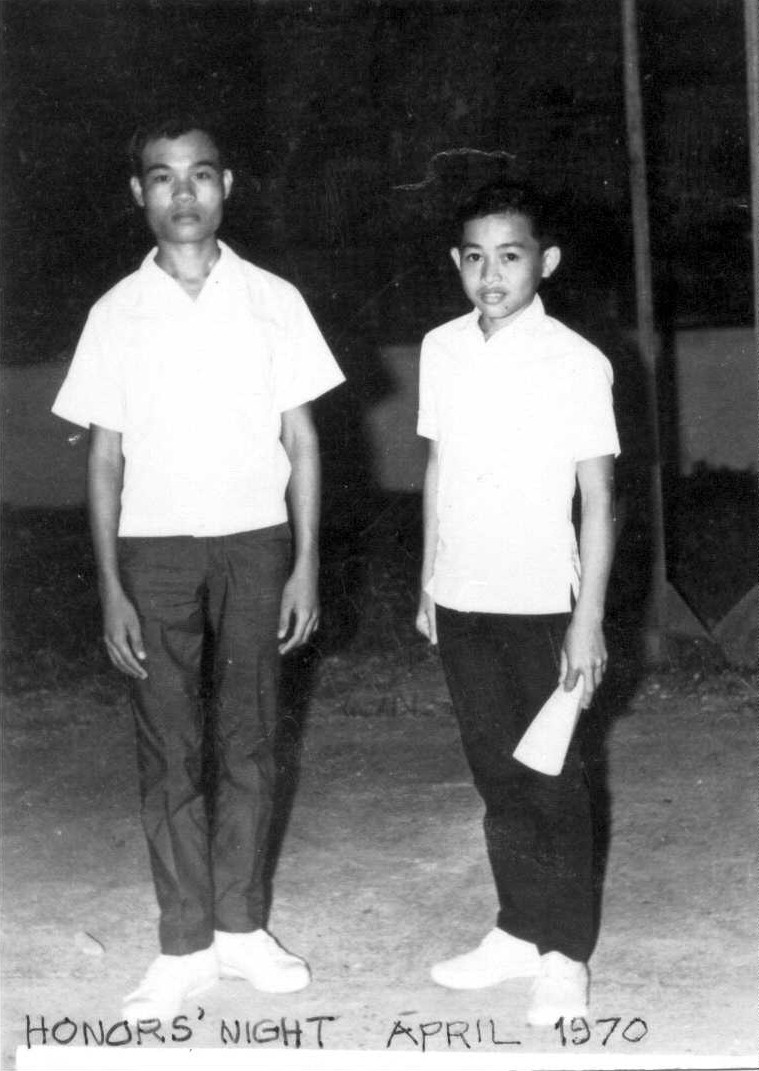
Emmanuel S. Bacleon, an ardent Filipino
nationalist and a passionate student activist in his time, died peacefully in
his home in Arleta, California last April 7, 2010. He was 58.
Manny's unassuming personality, humility
and sincerity endeared him to his friends. He was a dutiful son to his parents
and a caring brother to his siblings.
He was born on August 20, 1951 in
Cabadbaran, Agusan del Norte, Philippines, the fifth child among the nine
children of Melencio Ala-an Bacleon and Irene Josefa Antiga Sarita. His father
was a tailor and his mother was a full-time housewife. After finishing his
elementary education at Candelaria Institute in Cabadbaran, he entered the
Sacred Heart Seminary in Lawaan, Talisay, Cebu.
His high school classmates Celestino
Mausisa and Mercurio Montenegro fondly remember him as small in stature with a
big heart and very approachable especially when it came to helping them in
their Latin subject where Manny excelled. He was the valedictorian of class
1967.
After his high school graduation, he stayed in
the seminary for two more years as a college student majoring in Philosophy.
Upon the encouragement and a scholarship offer from Fr. Matthew van Santvoord,
MSC, at the time, the parish priest of Cabadbaran and Director of Candelaria
Institute, Manny left the seminary and took up BS Physics at the University of
San Carlos in Cebu City starting on the summer of 1969.
He was just few months into the university
when he discovered his debating skills and polished it by joining debating
contests and garnering awards as Best Debater and as Best Speaker during the
USC debate in the same summer that he entered the university. For some time he
was president of the USC Debating Team.
During these times, the Philippines was
simmering in a political turmoil. Student protests filled the air and on the
streets. Manny found himself in the midst of heightened student activism and
together with the rest of the studentry in the whole country took up the cudgel
of toppling down the oppressive regime that was becoming unpopular by the day.
He
joined several student organizations. Due to his oratorical mastery he rose
from the ranks and became the Secretary General of Samahang Demokratikong
Kabataan (Society of Democratic Youth) in the province of Cebu. Later he joined
the hard core revolutionary group Kabataang Makabayan (Patriotic Youth) and
became one of its top leaders.
He was about to finish his studies in San
Carlos when martial law was declared by then President Ferdinand Marcos. Manny
was among those wanted by the military being one of the top student leaders and
he went into hiding to elude arrest.
A few days before Christmas, Manny was
with his sister Gilda attending the Misa de Gallo at the Santo Rosario Church
in P. del Rosario Street in Cebu City when military-looking men approached them
and whisked Manny away. Gilda remembers that day very well: December 16, 1972.
Manny never returned to their boarding
house which was just located near the church. That afternoon at about 6 PM,
Gilda received a call from the military camp in Jones Avenue informing her that
Manny was in detention and that she had to bring him clothing, mat, mosquito
net and other personal belongings. He stayed in the stockade in Jones Avenue
for a few months. He was later transferred to Camp Lapu-lapu in Lahug, Cebu
City.
While in detention, he joined tournaments in
the game of chess with his fellow political prisoners and he won many times in
those games. His sister Gilda visited him every week and brought him food and
news stories of what's happening in the country. The prisoners had no access to
newspapers, TV and radio.
In the summer of 1974, Manny was
transferred to Fort Bonifacio Rehabilitation Center in Makati where he suffered
torture and deprivation which caused him and other detainees to launch hunger
strike. His sister Gilda got a first-hand experience of how relatives of
detainees felt shame and humiliation as they underwent strict body search and
inspection before they could see their imprisoned kin.
By this time, some concerned sector of the
Philippine society started organizing themselves to help detainees and their
families through legal channels. Foremost among these organizations was the
Task Force Detainee who worked for the release of the political prisoners.
Prominent nationalist lawyers like the late Senators Jose Diokno and Lorenzo
Tanada extended their legal expertise and their resources through these
organizations.
Manny was a beneficiary of these concerted
efforts. He was released from prison weak and emaciated. His body bore scars
due to physical torture. Later on his sisters realized that he bore
psychological scars too. He was no longer the energetic and enthusiastic person
that they used to know.
After his release he came to the United
States to join his parents and some of his siblings who were already residing
here. His years in prison made him incapable of finding work in his new
country. But his sisters and brother were supportive of him. He was in constant
medication to keep those mental demons restrained and to keep him from having
nervous breakdown. Freed from the rigors of employment, his typical day
included going to the library to read any book that interested him. He also
tutored his nieces in their math and science lessons.
Manny had one dream that persisted up to
the day he died. He wanted to go back to the Philippines to help his struggling
countrymen in any way he could. But his sisters won't let him. Manny is gone
but his indomitable spirit lives on
To many of his colleagues who were
infected by his enthusiasm and learned from him, he is a hero. In the words of
Dr. Raul Monton, a colleague who considered him his mentor during the student
activism days, "He was such a likable and a fiercely unselfish nationalist
who dedicated his life to serving the Filipino. He was unwavering in his
conviction. There are only a few Filipinos like him. I will not forget the days
we were together fighting the Dictatorship while others were just enjoying in
their comfort zone."
Finally, Manny's favorite quotation is worth
contemplating: "Every person dies; but each death varies in
significance." Indeed, Manny's death was significant. But it was because
he led a significant life, touching the lives of countless of his countrymen. A
life that was willing to sacrifice for what he believed in.
Epilogue
I wrote this piece as a eulogy during Manny's wake. Like Dr. Monton, I also considered Manny as my mentor. I first met him in the summer of 1971 when I attended a teach-in seminar conducted by him and other vacationing student leaders from Cebu and Manila. Manny and his group converted me and my friend, Misach, overnight and opened our understanding on the relevant political issues of the country at the time. I lost track of him after martial law was declared.
Thirty years later, I would meet him again in Los Angeles, California. He was sharing an apartment with their mother in San Fernando Valley while I was then teaching at a nearby city of Oxnard. I was a frequent visitor in their apartment during weekends where we enjoyed reminiscing our student activism days. Manny and I were actively involved in the organizational formation of the Cabadbaranons of Southern California where we were both elected as Public Relations officers. The following year, I transferred to New York and then to Alabama.
I returned to California in late February of 2010. I informed Manny that I was back and promised that I would visit him in a few weeks as soon as I get myself settled down and my schedule would allow me. That promise did not materialize. The week before my planned visit, his sister Emma informed me that Manny had already passed away.